
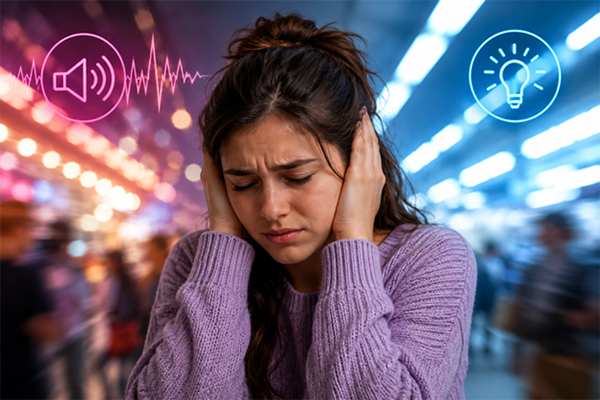
Everyday environments are filled with sounds, lights, and sensory input that most people can filter out easily. For many individuals with autism, however, these sensations can feel much stronger, overwhelming, or even uncomfortable.
If you or your child are sensitive to noise, bright lights, or busy environments, it may be related to how autism affects sensory processing.
What Does “Sensory Sensitivity” Mean in Autism?
Sensory sensitivity refers to how the brain receives and processes information from the environment. In autism, this process may be heightened, meaning that sounds, lights, textures, or other stimuli can feel more intense than usual.
This is not a choice. It reflects how the nervous system responds to sensory input.
Common Signs of Sensory Sensitivity
1. Sensitivity to Loud Sounds
Covering ears or reacting strongly to noise.
2. Discomfort With Bright Lights
Avoiding bright or flickering lights.
3. Difficulty in Busy Environments
Feeling overwhelmed in crowded or noisy places.
4. Strong Reactions to Sudden Stimuli
Startling easily with unexpected sounds or light changes.
5. Avoidance Behaviors
Trying to avoid certain environments or situations.
6. Irritability or Distress
Becoming upset due to sensory overload.
7. Need for Quiet or Calm Spaces
Seeking environments with less stimulation.
Why Sounds and Lights Feel More Intense
Several underlying factors contribute to this experience:
- Sensory Processing Differences
The brain may amplify incoming sensory signals. - Difficulty Filtering Input
Background noise or light may be harder to ignore. - Neurological Sensitivity
The nervous system may respond more strongly to stimuli. - Sensory Overload
Too much input at once can become overwhelming. - Predictability Challenges
Sudden or unexpected stimuli can increase discomfort.
How This Affects Daily Life
Sensory sensitivity can impact:
- School or work environments
- Social interactions
- Daily routines
- Emotional regulation
- Comfort in public spaces
Without understanding the cause, these reactions may be misunderstood as behavioral issues.
When to Seek Help From a Specialist
Consider a professional evaluation if:
- Sensory sensitivities interfere with daily activities
- There is frequent distress in certain environments
- Avoidance limits participation in routines
- Reactions feel intense or unpredictable
A specialist can help identify sensory patterns and provide tailored support.
Strategies and Support Options
Support often includes practical and environmental adjustments:
- Using Noise-Reducing Tools
Headphones or earplugs in loud environments. - Adjusting Lighting
Softer or natural lighting when possible. - Creating Calm Spaces
Providing quiet areas for breaks. - Gradual Exposure
Slowly increasing tolerance to certain stimuli. - Predictable Environments
Reducing unexpected sensory input. - Occupational Therapy
Helps manage sensory processing differences.
With the right support, individuals can better manage sensory input and reduce overwhelm.
About Dr. Priti Kothari
Dr. Priti Kothari is a board-certified child, adolescent, and adult psychiatrist providing comprehensive mental health care in Boca Raton. She specializes in ADHD, anxiety, depression, and stress-related conditions, offering comprehensive evaluations and personalized treatment plans for children, teens, and adults, including challenges related to sensory sensitivities, emotional regulation, and daily functioning.
Dr. Kothari helps individuals understand sensory experiences, reduce overwhelm, and build strategies for a more comfortable daily life.
Frequently Asked Questions
Is sensory sensitivity common in autism?
Yes, it is a core feature for many individuals.
Are sounds and lights actually louder or brighter?
They may not be physically different, but they can feel more intense.
Can children and adults both experience this?
Yes, sensory sensitivity can occur at any age.
Can this improve over time?
Yes, with the right strategies and support.
Does therapy help with sensory issues?
Many individuals benefit from occupational and sensory-based therapies.