
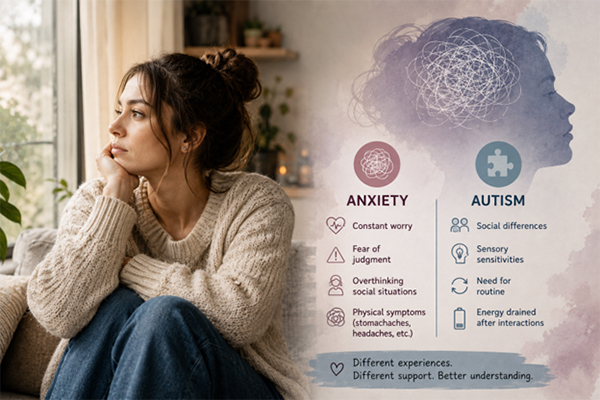
Anxiety and autism can sometimes look similar on the surface, especially in women. Many women who experience ongoing stress in social situations, overthinking, or emotional overwhelm are often diagnosed with anxiety, even when there may be underlying autistic traits.
If you or someone you know has been treated for anxiety but still feels misunderstood or continues to struggle in certain ways, it may be helpful to understand how autism can present differently in women.
What Makes Anxiety and Autism Look Similar?
Both anxiety and autism can involve:
- Discomfort in social situations
- Overthinking conversations
- Sensitivity to environments
- Emotional overwhelm
- Avoidance of certain situations
Because these experiences overlap, it can be difficult to distinguish between the two without a deeper evaluation.
Common Signs That May Be Misinterpreted
1. Social Discomfort
May be seen as anxiety but could reflect difficulty with social communication.
2. Overthinking Conversations
Often linked to anxiety, but may also involve processing differences.
3. Avoiding Social Situations
Can result from anxiety or from feeling overwhelmed by social demands.
4. Sensory Sensitivity
Sensitivity to noise, light, or crowds may be mistaken for anxiety.
5. Need for Routine
Preference for predictability may be misunderstood as anxious behavior.
6. Emotional Exhaustion
Feeling drained after interactions can be linked to masking or overstimulation.
7. Masking Behavior
Adapting socially may hide underlying autistic traits.
Why Autism Is Often Missed in Women
Several factors contribute to this confusion:
- Social Masking
Many women learn to hide or adapt their differences. - Gender Expectations
Social norms may encourage women to appear more socially adaptable. - Internalized Symptoms
Challenges may present as anxiety rather than outward behaviors. - Diagnostic Bias
Traditional diagnostic criteria have historically been based on male presentations. - Overlap With Anxiety Disorders
Similar symptoms can lead to misdiagnosis.
Key Differences Between Anxiety and Autism
While they can overlap, there are important distinctions:
- Anxiety is primarily related to fear, worry, and anticipation of negative outcomes
- Autism involves differences in social communication, sensory processing, and patterns of thinking
In some cases, both conditions may be present together.
How This Affects Daily Life
Misunderstanding the root cause can impact:
- Access to the right support
- Emotional well-being
- Self-understanding and identity
- Effectiveness of treatment approaches
- Long-term stress and burnout
Many women report feeling misunderstood before receiving the correct diagnosis.
When to Seek a Professional Evaluation
Consider a comprehensive evaluation if:
- Anxiety treatment has not fully addressed your challenges
- Social interactions feel consistently effortful
- You rely heavily on masking behavior
- Sensory sensitivities are significant
- You feel different but cannot fully explain why
A specialist can help differentiate between anxiety, autism, or both.
Support and Treatment Options
Support may include a combination of approaches:
- Accurate Diagnosis
Understanding the root cause of symptoms. - Therapy Tailored to Individual Needs
Addressing both anxiety and autism when present. - Reducing Masking When Possible
Encouraging authentic expression. - Managing Sensory Sensitivities
Creating comfortable environments. - Building Self-Awareness
Understanding personal patterns and needs. - Community Support
Connecting with others who share similar experiences.
With the right support, individuals can better understand themselves and find strategies that truly help.
About Dr. Priti Kothari
Dr. Priti Kothari is a board-certified child, adolescent, and adult psychiatrist providing comprehensive mental health care in Boca Raton. She specializes in ADHD, anxiety, depression, and stress-related conditions, offering comprehensive evaluations and personalized treatment plans for children, teens, and adults, including complex presentations where anxiety and neurodevelopmental differences may overlap.
Dr. Kothari helps individuals gain clarity, receive accurate diagnoses, and develop personalized strategies for long-term well-being.
Frequently Asked Questions
Can autism be mistaken for anxiety in women?
Yes, overlapping symptoms and masking can lead to confusion.
Can someone have both anxiety and autism?
Yes, they can occur together.
Why is autism harder to recognize in women?
Because it may present differently and be masked more often.
Does correct diagnosis make a difference?
Yes, it helps guide more effective support and treatment.
Can adults be diagnosed later in life?
Yes, many women are diagnosed in adolescence or adulthood.