
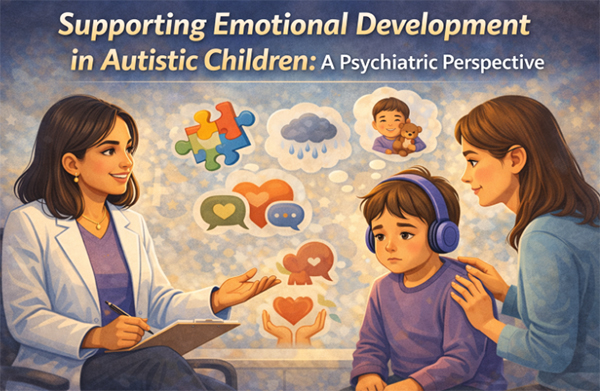
Autism Spectrum Disorder (ASD) is a neurodevelopmental condition that affects communication, social interaction, and behavior. One of the most important aspects of care for autistic children is supporting their emotional development. Emotional growth lays the foundation for resilience, self-regulation, and healthy relationships. As a psychiatrist in Boca Raton, I often guide families on strategies to nurture emotional skills in children with autism - balancing clinical expertise with compassion.
Understanding Emotional Development in Autism
Children with autism may experience emotions differently than neurotypical peers. Common challenges include:
- Difficulty recognizing emotions in themselves and others
- Limited emotional expression or atypical responses
- Struggles with self-regulation, leading to meltdowns or withdrawal
- Sensory sensitivities that heighten emotional reactions
Despite these challenges, autistic children are capable of rich emotional lives. With the right support, they can learn to identify, express, and manage feelings effectively.
Why Emotional Development Matters
Resilience: Emotional skills help children cope with stress and adapt to change.
Relationships: Understanding emotions fosters stronger bonds with family, peers, and teachers.
Learning: Emotional regulation improves focus and participation in school.
Independence: Emotional awareness supports decision-making and self-advocacy.
Psychiatric Perspective: Key Strategies
As a psychiatrist in Boca Raton, I emphasize evidence-based approaches to support emotional growth in autistic children.
1. Emotion Recognition Training
- Use visual aids like emotion cards or apps.
- Practice labeling feelings during daily routines.
- Encourage role-play to explore different emotional scenarios.
2. Social Stories and Modeling
- Social stories help children understand emotional contexts.
- Parents and caregivers can model calm responses to stress.
- Repetition reinforces emotional learning.
3. Sensory Regulation Techniques
- Identify triggers (noise, lights, textures).
- Provide calming tools such as weighted blankets or sensory toys.
- Create safe spaces for emotional decompression.
4. Cognitive Behavioral Strategies
- Teach coping skills like deep breathing or counting.
- Break down overwhelming tasks into manageable steps.
- Reinforce positive emotional responses with praise.
5. Family Involvement
- Parents play a central role in emotional coaching.
- Siblings can be included in activities to foster empathy.
- Family therapy sessions strengthen communication and support.
6. Professional Support
- Psychiatrists and therapists provide tailored interventions.
- Medication may be considered for co-occurring conditions like anxiety.
- Collaboration with schools ensures consistent emotional support.
Practical Tips for Parents
- Routine is key: Predictability reduces anxiety and supports emotional regulation.
- Celebrate small wins: Acknowledge progress in emotional expression.
- Use visual schedules: Helps children anticipate transitions and manage feelings.
- Encourage creative outlets: Art, music, or play therapy can unlock emotional expression.
- Stay patient and consistent: Emotional growth takes time and repetition.
Conclusion
Supporting emotional development in autistic children is both a challenge and an opportunity. With structured strategies, compassionate guidance, and professional support, children can thrive emotionally and socially.
Dr. Priti Kothari, a trusted psychiatrist in Boca Raton, works closely with families to nurture emotional skills in autistic children - helping them build resilience, independence, and meaningful connections.
FAQs
- Why is emotional development harder for autistic children?
Autistic children may struggle with recognizing and expressing emotions due to differences in social communication and sensory processing.
- How can parents help at home?
Parents can use visual aids, routines, and calming techniques to support emotional growth.
- What role does a psychiatrist play?
A psychiatrist in Boca Raton like Dr. Priti Kothari provides diagnosis, therapy, and guidance tailored to each child’s emotional needs.
- Are medications used for emotional regulation in autism?
Medication may be prescribed for co-occurring conditions such as anxiety or ADHD, but emotional skills are primarily taught through therapy and behavioral strategies.
- Can autistic children learn empathy?
Yes, with support, many autistic children develop empathy and emotional awareness, though it may look different from neurotypical expressions.
- What therapies are most effective?
Cognitive behavioral therapy, play therapy, and family counseling are commonly used to support emotional development.
References
- American Psychiatric Association.
Diagnostic and Statistical Manual of Mental Disorders (DSM-5-TR): Autism Spectrum Disorder.
https://www.psychiatry.org/psychiatrists/practice/dsm - Centers for Disease Control and Prevention (CDC).
Autism Spectrum Disorder (ASD): Treatment and Intervention Services.
https://www.cdc.gov/autism/treatment/index.html - National Institute of Mental Health (NIMH).
Autism Spectrum Disorder – Symptoms, Diagnosis, and Treatment.
https://www.nimh.nih.gov/health/topics/autism-spectrum-disorders-asd - Lord, C., et al. (2020).
Autism spectrum disorder.The Lancet, 392(10146), 508–520.
https://www.thelancet.com/journals/lancet/article/PIIS0140-6736(18)31129-2/fulltext - Mazefsky, C. A., & White, S. W. (2014).
Emotion regulation: Concepts & practice in autism spectrum disorder.
Child and Adolescent Psychiatric Clinics of North America, 23(1), 15–24.
https://www.sciencedirect.com/science/article/pii/S1056499313000844 - Samson, A. C., et al. (2015).
Emotion regulation in autism spectrum disorder: A systematic review.
Autism Research, 8(1), 9–18.
https://onlinelibrary.wiley.com/doi/10.1002/aur.1387