
Many parents notice early on when their child is not talking as much as other children their age. A toddler who is not saying words, struggling to form sentences, or not responding to speech can raise an important and often anxiety-provoking question: Is this just a speech delay, or could it be autism?
While speech delay and Autism Spectrum Disorder (ASD) can sometimes look similar on the surface, they are not the same, and understanding the differences is key to getting your child the right support early. As a child psychiatrist in Boca Raton, Dr. Priti Kothari frequently helps families navigate this distinction through careful evaluation and evidence-based guidance.
What Is a Speech Delay?
A speech delay occurs when a child’s speech or language skills develop more slowly than expected for their age, but follow the typical pattern of development.
Children with speech delay may:
- Say fewer words than expected
- Have difficulty pronouncing words clearly
- Combine words later than peers
- Understand language better than they can express it
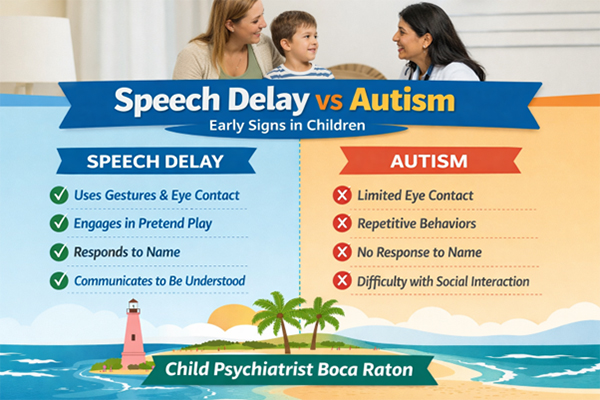
Importantly, children with speech delay usually want to communicate. They often:
- Use gestures like pointing or waving
- Make eye contact
- Respond to their name
- Show interest in social interaction
Speech delays can be caused by factors such as hearing issues, oral-motor difficulties, limited language exposure, or developmental language disorder. Many children with speech delay make significant progress with early speech therapy.
What Is Autism Spectrum Disorder (ASD)?
Autism Spectrum Disorder is a neurodevelopmental condition that affects communication, social interaction, and behavior. Speech delay can be one sign of autism, but autism involves more than just delayed speech.
Children with autism may experience challenges in:
- Social engagement and reciprocity
- Nonverbal communication (eye contact, facial expressions)
- Understanding social cues
- Flexible thinking and play
Speech patterns in autism may include:
- Delayed or absent speech
- Echolalia (repeating words or phrases)
- Unusual tone or rhythm of speech
- Difficulty using language for back-and-forth conversation
A child psychiatrist in Boca Raton can help distinguish whether speech challenges are isolated or part of a broader developmental pattern.
Key Differences Between Speech Delay and Autism
1. Social Interaction
- Speech Delay: Child seeks connection, enjoys playing with others, and responds to social cues.
- Autism: Child may appear less interested in social interaction or struggle with reciprocal engagement.
2. Nonverbal Communication
- Speech Delay: Uses gestures, facial expressions, and body language effectively.
- Autism: Limited or inconsistent use of gestures and eye contact.
3. Play Skills
- Speech Delay: Engages in pretend play and imitates others.
- Autism: May engage in repetitive play or have limited imaginative play.
4. Response to Name
- Speech Delay: Typically responds when called.
- Autism: May not consistently respond to their name.
5. Behavioral Patterns
- Speech Delay: Generally flexible with routines.
- Autism: May show repetitive behaviors or distress with changes in routine.
Why Early Evaluation Matters
Early identification allows for early intervention, which significantly improves long-term outcomes. If autism is present, therapies can address social communication, adaptive skills, and emotional regulation. If it is a speech delay, targeted speech therapy can often close developmental gaps.
A comprehensive evaluation by a child psychiatrist in Boca Raton may include:
- Developmental history
- Behavioral observations
- Parent interviews
- Collaboration with speech-language pathologists
- Standardized screening tools
When Should Parents Seek Help?
Consider seeking an evaluation if your child:
- Has no words by 16 months
- Is not combining words by age 2
- Rarely makes eye contact
- Does not point, wave, or show objects
- Loses previously acquired speech or social skills
- Appears disconnected from others
Trust your instincts. Early concerns deserve early attention.
Frequently Asked Questions (FAQs)
Can a child have both a speech delay and autism?
Yes. Many children with autism also have speech and language delays, but not all children with speech delays have autism.
Does late talking always mean autism?
No. Some children are simply late talkers and catch up with appropriate support.
Can speech therapy help children with autism?
Absolutely. Speech therapy is a core part of autism treatment and focuses on communication skills at all levels.
At what age can autism be diagnosed?
Autism can often be reliably diagnosed as early as 18–24 months by an experienced clinician.
Who should evaluate my child?
A developmental specialist or child psychiatrist in Boca Raton with experience in autism and speech development is best suited for a comprehensive assessment.
About Dr. Priti Kothari
Dr. Priti Kothari is a board-certified child, adolescent, and adult psychiatrist providing compassionate, individualized care in Boca Raton, Florida. She specializes in evaluating developmental concerns such as speech delays, autism spectrum disorder, ADHD, anxiety, and mood disorders.
Dr. Kothari takes a thoughtful, evidence-based approach, working closely with families to ensure accurate diagnosis and tailored treatment plans that support each child’s unique strengths and needs.
References
- American Academy of Pediatrics (AAP)
Autism Spectrum Disorder – Early Signs and Screening
https://www.aap.org/en/patient-care/autism/ - Centers for Disease Control and Prevention (CDC)
Learn the Signs. Act Early – Autism Spectrum Disorder
https://www.cdc.gov/autism/signs-symptoms/index.html - National Institute on Deafness and Other Communication Disorders (NIDCD)
Speech and Language Developmental Milestones
https://www.nidcd.nih.gov/health/speech-and-language - American Speech-Language-Hearing Association (ASHA)
Late Language Emergence and Speech Delay
https://www.asha.org/practice-portal/clinical-topics/late-language-emergence/ - DSM-5-TR – Diagnostic and Statistical Manual of Mental Disorders
Autism Spectrum Disorder Diagnostic Criteria
https://www.psychiatry.org/psychiatrists/practice/dsm - National Institute of Mental Health (NIMH)
Autism Spectrum Disorder Overview
https://www.nimh.nih.gov/health/topics/autism-spectrum-disorders-asd - Mayo Clinic
Autism Spectrum Disorder: Symptoms & Causes
https://www.mayoclinic.org/diseases-conditions/autism-spectrum-disorder