
By Dr. Priti Kothari, MD – Child, Adolescent & Adult Psychiatry

Parenting a child diagnosed with autism can feel like you’ve been handed a map with missing roads and sudden detours. Yet when approached with the right tools, mindset, and support, it can also be one of the most rewarding journeys a family can take. At her practice, Dr. Priti Kothari helps parents navigate this path with evidence-based strategies, compassion, and tailored interventions.
In this blog, you’ll find:
- Real-world parenting tips for supporting a child with autism
- Practical strategies to set up daily routines, improve communication, and regulate emotions
- Helpful ideas for sensory-friendly homes and family-friendly activities
- Statistics that highlight why early intervention matters
- A call-to-action for parents who want professional support
Why the Early Years Matter (and the Scale of the Issue)
- The prevalence of autism spectrum disorder (ASD) in the U.S. is 1 in 31 children aged 8 years (≈3.2%). Centers for Disease Control and Prevention (CDC), 2024
- Globally, about 1 in 127 persons were identified with autism in 2021. World Health Organization
These statistics highlight the widespread nature of autism and the importance of early, meaningful supports.
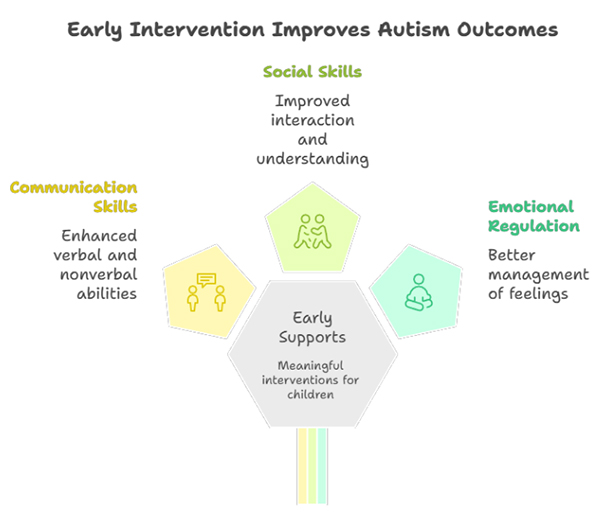
Because children’s brains are most adaptable in younger years, early intervention is essential. The sooner supports are put in place, the better the outcomes for communication, social skills, and emotional regulation.
- Building Consistent Daily Routines for Autistic Children
Why this matters
Children on the autism spectrum thrive when life is predictable. Routines reduce anxiety, build trust, and help children anticipate transitions.
How-to strategies
- Visual schedules: Use picture cues for daily activities (breakfast → school → therapy → play).
- Transition warnings: Offer 5-minute and 1-minute countdowns.
- Sensory check-ins: Ask “How do your senses feel?” before new activities.
- Built-in flexibility: Allow one “choice moment” daily to help build adaptability.
Strong daily rhythms reduce meltdowns and create calmer days for the whole family.
- Emotional Regulation & Managing Meltdowns
Understanding the challenge
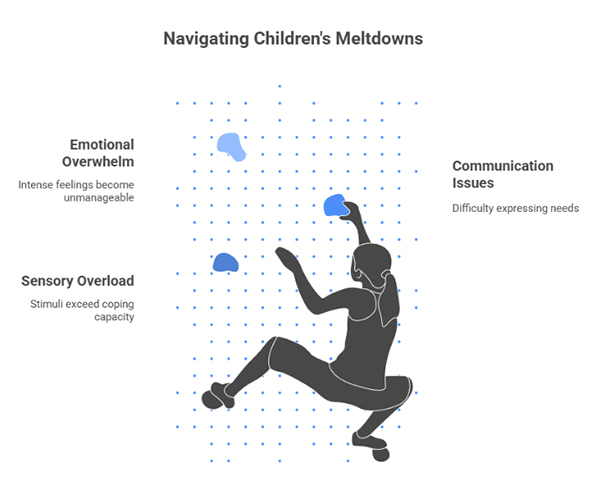
Meltdowns are often a result of sensory overload, communication challenges, or emotional overwhelm — not misbehavior.
Strategies
- Name emotions: Help children identify how they feel.
- Calm-down corner: Create a low-stimulus space with comforting items.
- Breathing exercises: Inhale 4 seconds → hold 2 → exhale 6.
- Social narratives: Use simple stories to explain events or expectations.
- Plan for sensory overload: Identify triggers and build in breaks.
Reframing meltdowns as communication helps parents respond proactively.
- Communication Strategies & Social Skills
Why it matters
Communication builds connection, independence, confidence, and social understanding — regardless of whether a child is verbal or non-verbal.
Strategies
- Visual supports: Cue cards, choice boards, gestures, visual aids.
- Turn-taking games: Strengthen reciprocity with simple back-and-forth play.
- Simplified language: Short, concrete phrases work best.
- Peer modelling: Structured play with neurotypical peers can help.
- Celebrate attempts: Progress matters more than perfection.
These strategies support communication and emotional development.
- Sensory-Friendly Home Ideas & Family Activities
Why sensory matters
Autistic children may be hyper- or hypo-sensitive to sound, touch, light, or movement. A sensory-friendly home helps reduce behavioral challenges and increases comfort.
Ideas
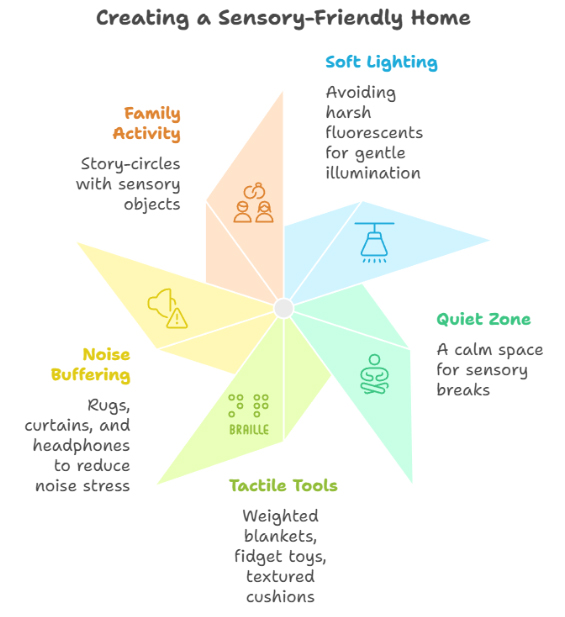
- Soft lighting: Avoid harsh fluorescents.
- Quiet zone: A calm space for sensory breaks.
- Tactile tools: Weighted blankets, fidget toys, textured cushions.
- Noise buffering: Rugs, curtains, and headphones help reduce noise stress.
- Family activity: Story-circles with sensory objects (smooth stones, soft scarves).
These small adjustments send a powerful message: “You are safe, seen, and supported.”
- Supporting the Whole Family & Siblings
Autism affects the entire family system, not just the child.
- Sibling support: One-on-one “sibling time” helps them feel seen.
- Parent self-care: Even 10 minutes of decompression matters.
- Family check-ins: Weekly meetings to share wins and challenges.
- Professional guidance: Early psychiatric, therapeutic, and counseling support can prevent long-term stress.
Call to Action
If you’re a parent or caregiver looking to build a stronger, more connected family life with your autistic child, you do not have to navigate the journey alone.
At Dr. Priti Kothari’s practice, you’ll find:
- Personalized assessments
- Targeted routines, communication strategies, and sensory support
- Parent-focused guidance to build confidence
- Sibling and family-level support
Book a consultation today atwww.drpritikothari.com
Let’s work together to create a journey filled with hope, connection, and meaningful progress.
References
- Centers for Disease Control and Prevention (CDC).Data & Statistics on Autism Spectrum Disorder (ASD).2024
https://www.cdc.gov/autism/data-research/index.html - National Institute of Mental Health (NIMH).Autism Spectrum Disorder (ASD) — Statistics & Research.2023
https://www.nimh.nih.gov/health/statistics/autism-spectrum-disorder-asd - Watson et al.The Experience of Being a Sibling of a Child with Autism: A Systematic Review.2021
https://pmc.ncbi.nlm.nih.gov/articles/PMC8264626/ - Ibañez et al.Enhancing Interactions During Daily Routines for Children with Autism Spectrum Disorder.2018
https://pmc.ncbi.nlm.nih.gov/articles/PMC5903955/ - Kirchhofer et al.Social Support and Family Dynamics in Households with a Child Diagnosed with Autism.2022
https://www.sciencedirect.com/science/article/pii/S0891422222000646