
Screens are everywhere - tablets for schoolwork, phones for socializing, TVs for entertainment. For many Florida parents, managing screen time has become one of the most common daily struggles, often ending in arguments, emotional outbursts, or complete shutdowns.
As a psychiatrist in Florida, I frequently hear parents say, "Taking away the screen is the only thing that causes a meltdown." The truth is, screen-related meltdowns are not about defiance or "bad behavior." They are often rooted in brain development, emotional regulation, and how technology affects a child's nervous system.
The good news? Screen time can be managed in a way that protects your child's mental health - without constant power struggles.
Why Screen Time Triggers Meltdowns
Screens stimulate the brain's reward system by releasing dopamine, the same chemical involved in motivation and pleasure. For children, whose brains are still developing, this stimulation can be intense. When screen time ends abruptly, it can feel like a sudden emotional crash.
Meltdowns often happen because:
- Transitions are too abrupt
- Screens are used to regulate emotions rather than support them
- Children lack alternative coping skills
- Expectations around screen use are inconsistent
Florida families also face unique challenges - hot weather limiting outdoor play for parts of the year, busy school schedules, and increased reliance on devices for learning and entertainment.
Signs Screen Time May Be Affecting Your Child's Mental Health
Occasional frustration is normal. However, as a psychiatrist in Florida, I encourage parents to pay attention if they notice:
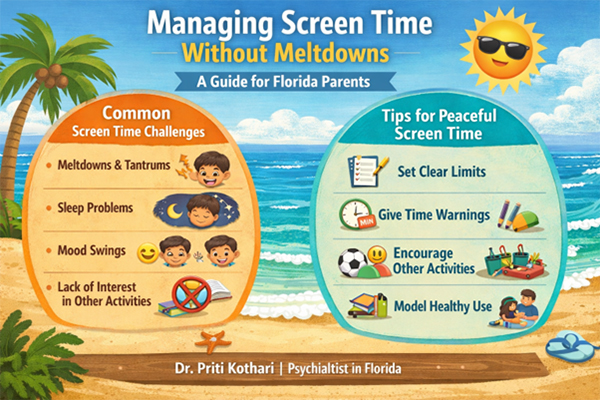
- Intense emotional reactions when screens are removed
- Irritability, aggression, or withdrawal after screen use
- Trouble sleeping or increased anxiety
- Loss of interest in non-screen activities
- Difficulty focusing or regulating emotions
These signs don't mean screens must be eliminated - but they do signal a need for healthier boundaries.
How to Manage Screen Time Without Power Struggles
1. Set Clear, Predictable Limits
Children do best when expectations are consistent. Create screen time rules that are:
- Specific (how long, when, and on which devices)
- Predictable (same rules daily)
- Age-appropriate
Avoid negotiating limits in the moment - decide them ahead of time.
2. Use Transitions, Not Abrupt Endings
Instead of "Turn it off now," give advance warnings:
- "10 more minutes"
- "One more episode"
- "Finish this level, then we stop"
This allows the brain time to shift gears and reduces emotional overload.
3. Don't Use Screens as the Primary Calming Tool
When screens become the main way a child soothes distress, emotional regulation skills don't develop. Encourage alternatives such as:
- Physical movement
- Deep breathing
- Drawing or journaling
- Talking through emotions
Screens should support life - not replace coping skills.
4. Model Healthy Screen Habits
Children learn more from what they see than what they're told. If screens dominate family time, children internalize that behavior. Set device-free times - meals, bedtime, and family conversations.
5. Focus on Quality, Not Just Quantity
Not all screen time is equal. Educational content, creative apps, or shared family viewing is very different from endless scrolling or gaming alone. Engage with your child around what they're watching or playing.

When to Seek Professional Support
If screen-related meltdowns are frequent, intense, or affecting school performance, sleep, or family relationships, it may be time to consult a mental health professional.
A psychiatrist in Florida can assess whether underlying concerns such as anxiety, ADHD, sensory processing challenges, or mood disorders are contributing to screen dependency and emotional dysregulation.
Early guidance can prevent long-term struggles and help families restore balance.
Screen Time and Emotional Health Can Coexist
Screens are not the enemy. The goal is not perfection - but balance. With structure, empathy, and consistency, children can learn to enjoy technology without becoming overwhelmed by it.
At Dr. Priti Kothari's practice, we work closely with families to understand the emotional and neurological factors behind behavior - not just manage symptoms.
Frequently Asked Questions (FAQs)
How much screen time is healthy for children?
There is no one-size-fits-all number. Younger children generally need stricter limits, while teens benefit from boundaries around content, timing, and sleep. A psychiatrist in Florida can help tailor recommendations based on your child's emotional needs.
Are screen time meltdowns a sign of addiction?
Not necessarily. Meltdowns often reflect difficulty with transitions and emotional regulation rather than addiction. However, persistent loss of control may require professional evaluation.
Should screens be completely removed as punishment?
Using screen removal as punishment can increase emotional distress and power struggles. It's more effective to treat screen limits as neutral household rules rather than consequences.
Can screen time worsen anxiety or ADHD?
Yes. Excessive or unstructured screen use can intensify anxiety, attention difficulties, and sleep problems in vulnerable children. Managing screen habits is often part of treatment.
When should I consult a psychiatrist?
If your child's behavior around screens is interfering with daily functioning, emotional well-being, or family relationships, consulting a psychiatrist in Florida can provide clarity and support.
Need professional guidance?
If screen time battles are taking a toll on your family, compassionate, evidence-based help is available. Schedule a consultation with Dr. Priti Kothari, a trusted psychiatrist in Florida, to support your child's emotional health and restore balance at home.
References
- American Academy of Pediatrics (AAP)
Children, Adolescents, and Digital Media
https://publications.aap.org/pediatrics/article/138/5/e20162593/60330 - Centers for Disease Control and Prevention (CDC)
Children's Mental Health & Technology Use
https://www.cdc.gov/childrensmentalhealth/features/technology-and-child-development.html - National Institute of Mental Health (NIMH)
Technology and Mental Health in Children
https://www.nimh.nih.gov/health/topics/child-and-adolescent-mental-health - Harvard Medical School – Harvard Health Publishing
Managing Screen Time for Kids
https://www.health.harvard.edu/blog/managing-screen-time-for-kids-2020032419291 - Mayo Clinic
Children and Screen Time: How Much Is Too Much?
https://www.mayoclinic.org/healthy-lifestyle/childrens-health/in-depth/screen-time/art-20047952 - American Psychological Association (APA)
Digital Media Use and Children's Mental Health
https://www.apa.org/monitor/2020/04/cover-kids-screens