
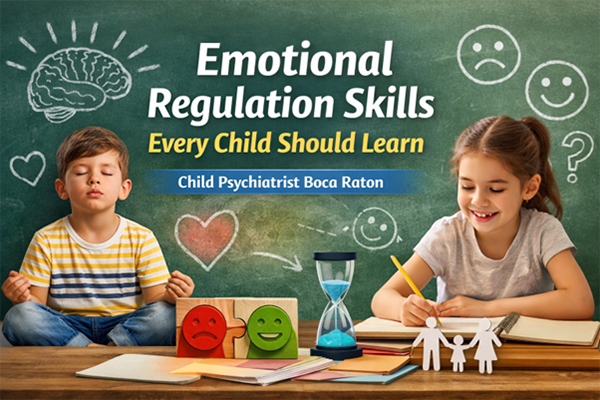
Emotional regulation is a critical life skill that shapes how children respond to stress, frustration, and social challenges. While emotions are a natural part of development, children often struggle to understand and manage them effectively. Teaching emotional regulation early helps children build resilience, strengthen relationships, and improve mental well-being. Support from a qualified child psychiatrist in Boca Raton can play a key role when emotional challenges become overwhelming.
What Is Emotional Regulation?
Emotional regulation refers to a child’s ability to recognize, understand, and manage their emotions in healthy and appropriate ways. This includes calming themselves when upset, expressing feelings constructively, and adapting emotional responses to different situations.
Children are not born with these skills. Emotional regulation develops gradually through guidance, modeling, and practice. Without these skills, children may experience frequent emotional outbursts, anxiety, or behavioral difficulties.
Why Emotional Regulation Matters in Childhood
Strong emotional regulation skills help children:
- Manage stress and frustration
- Improve focus and academic performance
- Build healthy peer relationships
- Develop empathy and self-awareness
- Reduce anxiety, anger, and impulsivity
When emotional challenges persist or interfere with daily life, consulting a child psychiatrist in Boca Raton can help identify underlying concerns such as anxiety disorders, ADHD, or mood-related conditions.
Essential Emotional Regulation Skills Every Child Should Learn
1. Identifying and Naming Emotions
Children must first learn to recognize what they are feeling. Teaching them emotional vocabulary such as “frustrated,” “disappointed,” or “overwhelmed” helps normalize emotions and encourages communication instead of emotional outbursts.
Parents and caregivers can model this by naming their own emotions and validating the child’s feelings without judgment.
2. Self-Soothing Techniques
Self-soothing allows children to calm themselves during emotional distress. These techniques may include deep breathing, counting, mindfulness exercises, or using sensory tools.
Practicing calming strategies regularly helps children access them more easily during moments of emotional intensity.
3. Emotional Expression in Healthy Ways
Children should learn that all emotions are valid, but not all behaviors are acceptable. Teaching appropriate ways to express emotions such as talking, drawing, or journaling reduces emotional suppression and prevents behavioral escalation.
A child psychiatrist in Boca Raton can guide families when emotional expression becomes disruptive or distressing.
4. Problem-Solving Skills
Helping children think through solutions when emotions arise builds independence and confidence. Encouraging questions like “What can we do to fix this?” shifts focus from emotional reaction to constructive action.
Problem-solving skills empower children to manage challenges instead of feeling overwhelmed by them.
5. Impulse Control
Impulse control enables children to pause before reacting. This skill is especially important for children with ADHD or emotional sensitivity. Teaching children to stop, breathe, and think before acting can significantly reduce emotional and behavioral challenges.
Professional support from a child psychiatrist in Boca Raton may be helpful when impulse control difficulties affect academic or social functioning.
When to Seek Professional Help
While emotional ups and downs are normal, professional evaluation may be necessary if a child:
- Has frequent emotional outbursts
- Experiences persistent anxiety or sadness
- Struggles with peer relationships
- Shows signs of emotional withdrawal
- Has difficulty regulating emotions across settings
Early intervention improves long-term emotional and psychological outcomes.
How a Child Psychiatrist Can Help
A child psychiatrist in Boca Raton specializes in assessing emotional, behavioral, and developmental challenges in children and adolescents. Treatment may include therapy, parent guidance, behavioral strategies, or medication when appropriate.
Collaborative care ensures children receive support tailored to their emotional needs.
FAQs
Q1: At what age should children learn emotional regulation?
Emotional regulation skills begin developing in early childhood and continue into adolescence. Early guidance improves long-term outcomes.
Q2: Can emotional regulation be taught at home?
Yes. Parents play a crucial role, but professional support is beneficial when challenges persist or escalate.
Q3: Is poor emotional regulation a sign of a mental health condition?
Not always. However, persistent difficulties may indicate anxiety, ADHD, or mood disorders that require evaluation.
Q4: How can a child psychiatrist help with emotional regulation?
A child psychiatrist provides assessment, therapy recommendations, and personalized treatment plans to improve emotional control.
About the Doctor
Dr. Priti Kothari is a board-certified child and adolescent psychiatrist providing compassionate, evidence-based care for children and teens. As a trusted child psychiatrist in Boca Raton, Dr. Kothari specializes in emotional regulation, anxiety, ADHD, and mood disorders, helping families navigate mental health challenges with clarity and confidence.
Medical References
- American Academy of Pediatrics (AAP)
Emotional Development in Children
https://www.aap.org - Centers for Disease Control and Prevention (CDC)
Children’s Mental Health and Emotional Well-Being
https://www.cdc.gov/childrensmentalhealth - American Academy of Child & Adolescent Psychiatry (AACAP)
Emotional Regulation and Child Development
https://www.aacap.org - National Institute of Mental Health (NIMH)
Mental Health in Children and Adolescents
https://www.nimh.nih.gov/health/topics/child-and-adolescent-mental-health - Harvard University – Center on the Developing Child
Emotional Regulation and Executive Function Skills
https://developingchild.harvard.edu