
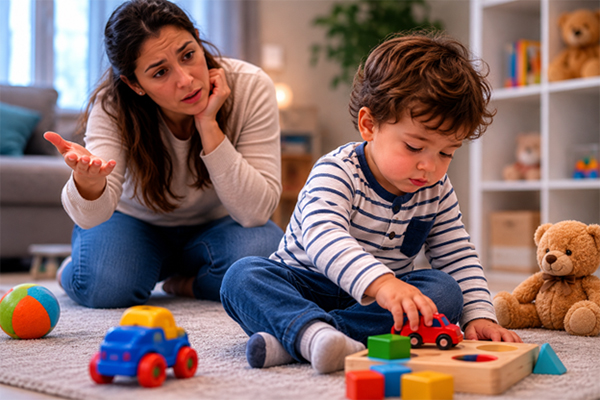
It can feel confusing or concerning when your toddler does not respond to their name consistently. At times, they may respond right away, while other times they seem to ignore you completely.
If you are noticing this pattern, it is important to understand that there can be several reasons behind it—many of which are related to development, attention, or communication rather than intentional behavior.
What Does This Mean?
Not responding to their name does not always mean a child is ignoring you. It may reflect how they are processing sound, attention, or social interaction.
In some cases, it can also be an early sign of developmental differences that may need further evaluation.
Common Signs
1. Inconsistent Response
Sometimes responding, sometimes not.
2. Being Deeply Engaged in Activities
Not reacting when focused on play.
3. Limited Eye Contact
Not looking toward the person calling them.
4. Delayed Reaction
Responding after repeated calls.
5. Responding More to Sounds Than Name
Reacting to noises but not to their name.
6. Seeming “In Their Own World”
Appearing less aware of others calling them.
7. Better Response in Quiet Environments
Responding more when there are fewer distractions.
Why This Happens
Several factors can contribute to this behavior:
- Normal Developmental Variation
Toddlers are still learning attention and communication skills. - Attention and Focus
Deep engagement in play can make it hard to shift attention. - Language Development Delays
Difficulty understanding or processing their name. - Hearing Concerns
Reduced hearing ability may affect response. - Sensory Processing Differences
Sounds may not be processed consistently. - Early Signs of Autism
In some cases, inconsistent name response can be an early indicator.
How This Affects Daily Life
This behavior may impact:
- Communication with caregivers
- Social interaction
- Following instructions
- Safety (responding when called)
Parents may feel unsure whether the behavior is typical or a cause for concern.
When to Seek Help From a Specialist
Consider a professional evaluation if:
- Your child rarely responds to their name
- There are concerns about hearing
- Speech or language is delayed
- There is limited eye contact or social interaction
- You notice other developmental concerns
Early evaluation can help identify whether support is needed.
Strategies and Support Options
Support often focuses on improving attention and communication:
- Use Their Name Clearly and Gently
Avoid repeating it too quickly or loudly. - Get to Their Eye Level
Helps capture attention. - Reduce Background Noise
Improves focus. - Pair Name With Positive Interaction
Use play or rewards when they respond. - Use Gestures Along With Calling
Combine visual and verbal cues. - Check Hearing if Needed
Rule out any auditory concerns. - Early Intervention Services
If developmental concerns are present.
With the right support, many children improve their response over time.
About Dr. Priti Kothari
Dr. Priti Kothari is a board-certified child, adolescent, and adult psychiatrist providing comprehensive mental health care in Boca Raton. She specializes in ADHD, autism, anxiety, and developmental concerns, offering comprehensive evaluations and personalized treatment plans for children, teens, and adults.
Dr. Kothari helps parents understand developmental patterns, identify early concerns, and support children in building communication and social skills.
Frequently Asked Questions
Is it normal for toddlers to ignore their name?
Sometimes, especially when they are deeply engaged in play.
When should I be concerned?
If your child rarely responds or shows other developmental delays.
Could this be a hearing problem?
Yes, hearing should be checked if there are concerns.
Is this linked to autism?
It can be an early sign, but not always. Evaluation is important.
Can this improve with time?
Yes, many children improve with support and development.