
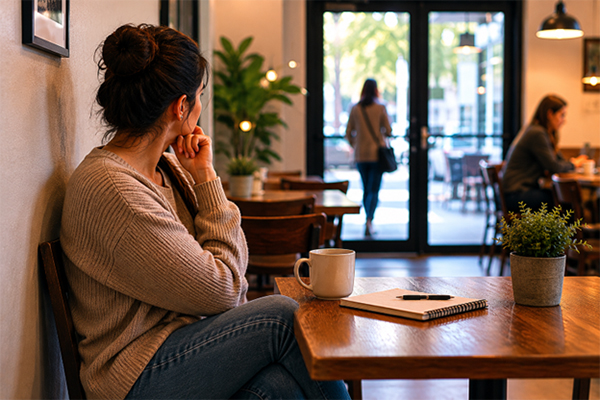
You may notice that some individuals with PTSD choose seats where they can clearly see the door or have their back against a wall. This preference is not random—it is often a way to feel safer and more in control of their surroundings.
If you or someone you know has this habit, it may be connected to how PTSD affects awareness, safety, and the body’s response to potential threats.
What Does This Mean?
In PTSD, the brain can remain highly alert to the environment, even in safe situations. Sitting in a position where entrances are visible or where there are fewer blind spots helps reduce uncertainty.
This behavior is often a form of self-protection, not a sign of mistrust or avoidance.
Common Signs of This Preference
1. Choosing Seats Facing the Door
Preferring positions where entrances are visible.
2. Avoiding Sitting With Back Exposed
Feeling uncomfortable when unable to see what’s behind.
3. Scanning the Environment
Frequently checking surroundings.
4. Feeling Uneasy in Certain Positions
Discomfort when unable to monitor the space.
5. Quick Reactions to Movement
Noticing changes in the environment quickly.
6. Preference for Predictable Seating
Choosing the same spot repeatedly.
7. Difficulty Relaxing in Open Spaces
Feeling more comfortable with boundaries like walls.
Why This Happens
Several underlying factors contribute to this behavior:
- Hypervigilance
The brain stays alert for potential threats. - Safety-Seeking Behavior
Positioning helps reduce uncertainty and increase control. - Conditioned Responses
Past experiences may reinforce the need to monitor surroundings. - Overactive Threat Detection
The brain is quicker to interpret changes as potential danger. - Need for Environmental Awareness
Seeing entrances reduces anxiety about the unknown.
How This Affects Daily Life
This preference can influence:
- Seating choices in restaurants or public places
- Comfort in social situations
- Ability to relax in unfamiliar environments
- Interactions with others
- Overall sense of safety
Others may misunderstand this as being overly cautious, when it is actually a coping strategy.
When to Seek Help From a Specialist
Consider professional support if:
- The need for control over surroundings causes distress
- It limits participation in daily activities
- There is constant anxiety in public spaces
- It affects relationships or functioning
A specialist can help reduce hypervigilance and build a greater sense of safety.
Strategies and Support Options
Support often focuses on gradually reducing anxiety and increasing comfort:
- Grounding Techniques
Helps bring attention back to the present moment. - Therapy (Trauma-Focused)
Supports processing of past experiences. - Gradual Exposure
Slowly building comfort in different seating positions. - Relaxation Techniques
Helps calm the nervous system. - Creating Predictable Environments
Reduces uncertainty. - Building Trust in Safe Spaces
Helps retrain the brain’s safety signals.
With the right support, individuals can feel more at ease in different environments over time.
About Dr. Priti Kothari
Dr. Priti Kothari is a board-certified child, adolescent, and adult psychiatrist providing comprehensive mental health care in Boca Raton. She specializes in ADHD, anxiety, depression, PTSD, and stress-related conditions, offering comprehensive evaluations and personalized treatment plans for children, teens, and adults.
Dr. Kothari helps individuals understand trauma-related behaviors, reduce hypervigilance, and develop strategies to feel safer and more comfortable in everyday situations.
Frequently Asked Questions
Why do people with PTSD prefer facing the door?
It helps them feel more aware and in control of their surroundings.
Is this behavior common?
Yes, it is a common response linked to hypervigilance.
Does this mean they feel unsafe?
Not necessarily, but their brain may still be scanning for potential threats.
Can this behavior change over time?
Yes, with therapy and supportive strategies.
Should this be corrected?
It’s important to understand it first; support should be gradual and respectful.